
Every year, thousands of residential remodels, accessory dwelling units (ADUs), and custom home builds fail their final building or fire-marshal Certificate of Occupancy walk-through over a $60 oversight: undersized, script-spelled, or low-contrast address numbers. Understanding International Fire Code (IFC) Section 505.1—along with International Residential Code (IRC) Section R319.1 and local setback escalators—ensures your signage passes inspection on day one and remains readable from a moving fire engine in driving rain.
The Four Core Mandates of IFC Section 505.1 & IRC R319.1
Adopted as the model life-safety code across the vast majority of U.S. cities and counties, IFC Section 505.1 (Premises Identification) and its residential counterpart IRC Section R319.1 (Address Identification) establish four mandatory criteria for both new and existing buildings:
- Plain, Legible Arabic Numerals or Alphabetical Letters: Addresses must be displayed as crisp numerals (
2408)—never spelled-out cursive script words (Twenty-Four Oh Eight), which fail inspection in nearly every jurisdiction because rapid pattern recognition drops sharply under stress or low light. - High Visual Contrast Against the Background: Brass numbers on honey-stained cedar, brushed nickel numbers on light gray stucco, or matte-black numbers on dark espresso trim routinely fail inspection. Fire inspectors look for unmistakable light-on-dark or dark-on-light luminance separation.
- Minimum 4-Inch (102 mm) Character Height: Each numeral must measure at least
4 incheshigh from baseline to cap height. Note that 4 inches is the bare code floor for close urban setbacks—not an all-purpose recommendation. - Minimum 0.5-Inch (12.7 mm) Stroke Width: Ultra-thin hairline modernist fonts look sleek in architectural renderings, yet their narrow stems vanish beyond 45 feet. A
0.5-inchminimum stroke width ensures digits hold their shape under vehicle headlights.
Why 4-Inch Digits Fail on Suburban & Deep Setback Lots
Human visual acuity and municipal fire amendments scale directly with viewing distance—measured from the centerline of the public street (not your front sidewalk) to the mounted plaque, factored alongside posted traffic speed. At 35 mph, an ambulance or engine company travels 51 feet per second. If your house sits 95 feet back from the crown of the street, 4-inch digits subtend too small an angle for an operator scanning both sides of an unfamiliar road at night.
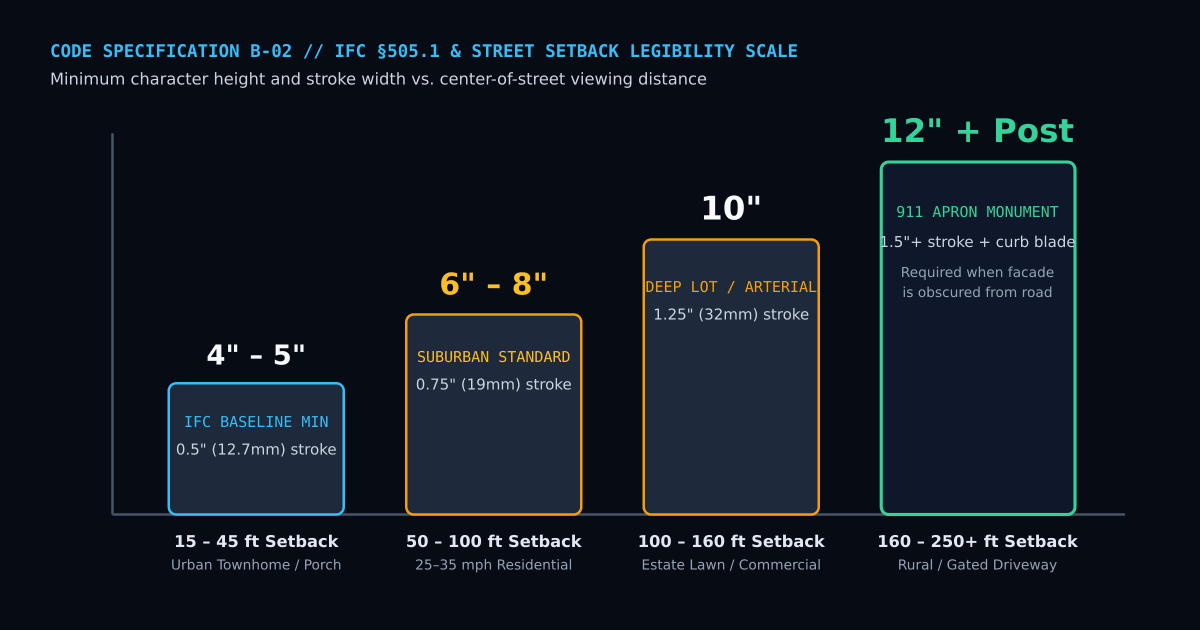
Consequently, dozens of county fire departments, Wildland-Urban Interface (WUI) ordinances (such as California PRC §4291 / Title 14 §1274), and suburban municipalities override the 4-inch model baseline with setback-graduated tables:
| Center-of-Street Setback | Model IFC Baseline | Common Municipal / WUI Amendment | Recommended Architectural Height | Minimum Stroke Width |
|---|---|---|---|---|
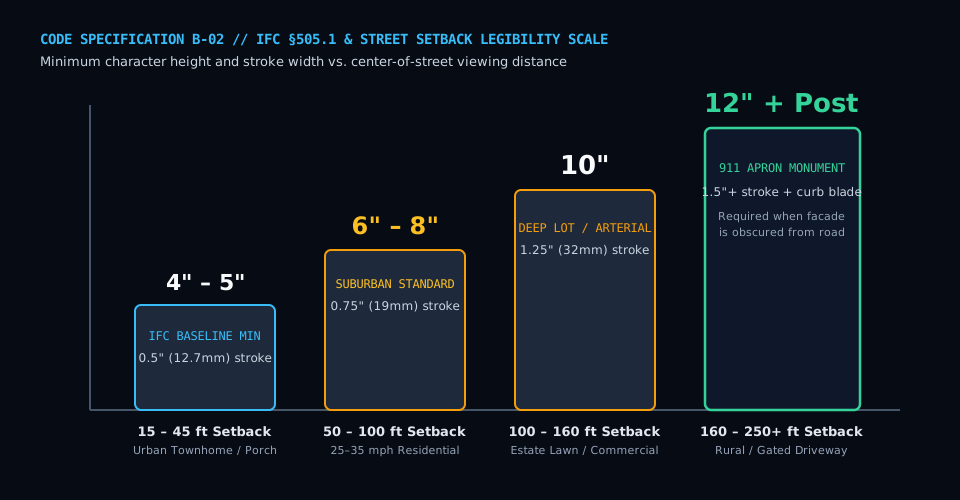
| 15 - 45 ft (Townhome / Urban) | 4 in (102 mm) | 4 in - 5 in | 5 in - 6 in | 0.50 in (12.7 mm) |
| 50 - 95 ft (Suburban Lot) | 4 in (102 mm) | 6 in (152 mm) | 6 in - 8 in | 0.75 in (19.0 mm) |
| 100 - 160 ft (Estate Setback) | 4 in (102 mm) | 8 in - 10 in | 10 in (254 mm) | 1.00 - 1.25 in |
| Over 160 ft or Obscured Facade | Monument / Post at Road | 4 in - 6 in reflective at driveway apron + house sign | 12 in on facade + 911 Curb Blade | 1.25 - 1.50 in |
Line-of-Sight Obstructions: Garage Eaves, Columns & Mature Trees
IFC §505.1 explicitly requires that address identification be placed in a position that is plainly legible and visible from the street or road fronting the property. Inspectors check visibility from both directions of approach—not merely standing directly in front of your walkway. Three placement mistakes account for most failed inspections:
- Deep Porch Soffits & Columns: Mounting numbers high above a recessed front door looks symmetrical from the front path, but porch columns and overhanging eaves block the numbers from 45-degree street approach angles. Moving the numbers onto the forward-most garage pier or masonry column solves the sightline immediately.
- Seasonal Foliage & Climbing Vines: Ornamental crepe myrtles, bougainvillea, and olive trees planted beside entry piers grow across eye-level plaques within two summers. Keep a clear pruning envelope around all address hardware.
- Parked Vehicles in Driveways: Plaque monuments set lower than 36 inches near a parking pad are routinely hidden behind SUVs or delivery vans. Post-mounted driveway signs should sit 42 to 60 inches above road crown grade, set back just outside the municipal snowplow or mower shoulder.
ADU, Rear Alley & Flag-Lot Wayfinding Rules
When a parcel includes a detached Accessory Dwelling Unit (ADU), carriage house, or flag-lot residence not directly visible from the fronting street, fire codes require a permanent directional plaque at the street entrance (for example, 2408-B REAR ->) repeated at every fork in the pedestrian path and on the ADU entry elevation itself, often paired with dusk-to-dawn illumination.
Font Geometry: Choosing Typefaces That Pass Stroke-Width Measurement
When an inspector pulls a tape measure across a number, they measure the narrowest primary vertical or diagonal stem—not the widest serif flourish. Geometric grotesque and architectural sans-serif styles (inspired by Neutraface Bold, Futura Medium-Bold, Helvetica Neue Bold, DIN 1451 Mittelschrift, and Highway Gothic Series C/D) maintain uniform stroke thickness, wide open counters inside 6, 8, and 9, and unmistakable differentiation between 1 and 7. Avoid condensed display fonts where internal apertures pinch shut when halo-backlit at night.
Need Sizing Verification or a Custom Plaque Quote?
Test your address on our Live Day/Night Halo Simulator or email your facade photo and street setback to info@housesignage.com.