
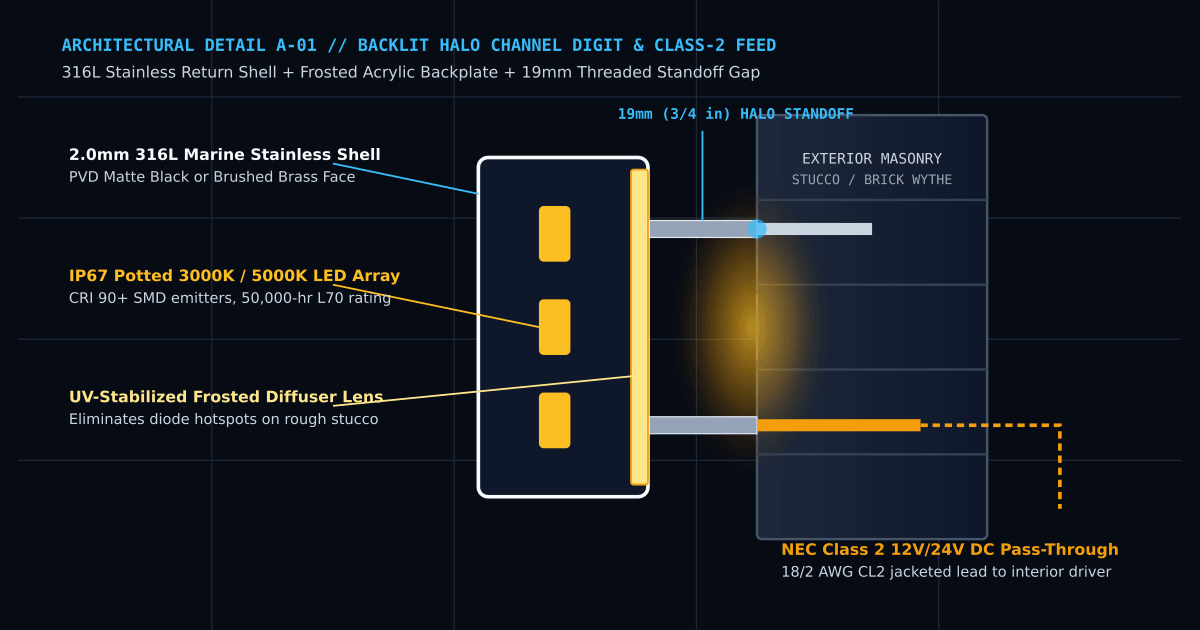
Unlit metal digits disappear the moment twilight settles across a textured stucco or dark brick facade. Delivery drivers slow-crawl past driveways, guests miss turnoffs, and paramedics lose critical seconds scanning porch shadows. Choosing between hardwired 12V/24V halo-lit channel numbers and self-contained solar address plaques comes down to three physical variables on your property: wall access behind the mounting surface, daily winter sun hours, and desired luminance consistency from dusk until dawn.
How Reverse-Channel Halo LED House Numbers Work
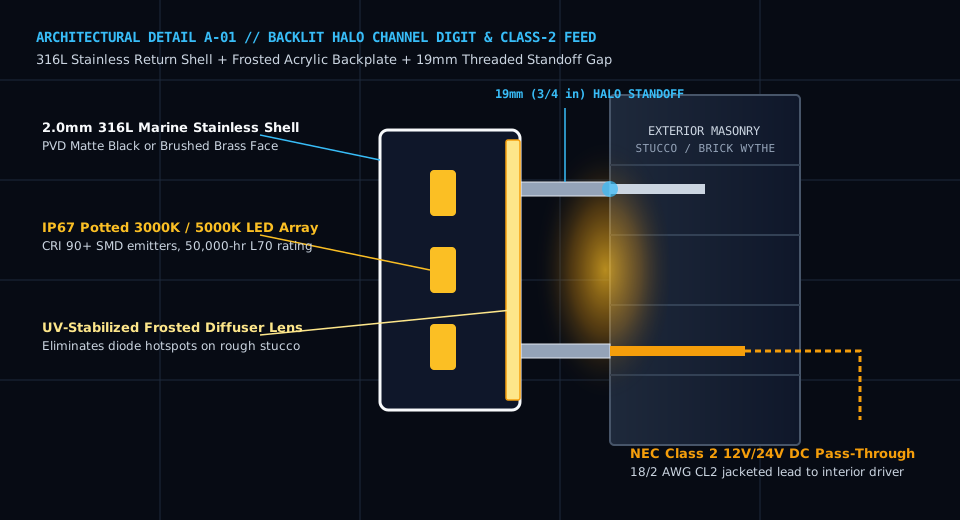
True architectural backlit digits are fabricated as hollow metal shells—most commonly laser-welded 316L marine stainless steel or CNC-machined cast aluminum—fitted with a recessed, UV-stabilized frosted polycarbonate or cast acrylic backplate. Potted IP67 surface-mount LED emitters sit inside the cavity facing the wall rather than the street. When mounted on 13mm to 19mm (1/2-inch to 3/4-inch) threaded standoffs, the opaque metal face blocks direct glare while projecting a crisp corona around every stroke.
Because the viewer reads the dark silhouette of the numeral against a luminous halo on the wall, surface reflectance matters enormously. Smooth Santa Barbara stucco, painted fiber-cement lap siding, limestone veneer, and light mortar joints bounce warm 3000K light evenly. Deep charcoal board-and-batten or dark clinker brick absorbs up to 75 percent of incident light, which is why dark facades either require a contrasting backer plaque behind the floating numbers or a step up in emitter flux.
NEC Class 2 Low-Voltage Wiring: Doorbell Tap vs. Dedicated Driver
Hardwired LED house numbers NEVER connect directly to 120V AC household branch circuits. Every legitimate exterior LED digit operates on safe, low-voltage 12V DC (or 24V DC for long commercial runs) supplied by a UL 1310 / NEC Article 725 Class 2 power source. Homeowners and electricians typically choose one of three power paths:
- Dedicated Plug-In or Hardwired Class 2 LED Driver: Installed inside an adjacent garage bay, basement joist space, or utility closet, fed through a photocell or astronomical smart plug so the address illuminates automatically from sunset to sunrise.
- Landscape Lighting Transformer Integration: Many 12V AC/DC compatible address numbers include an internal bridge rectifier, allowing you to tie them directly into an existing low-voltage landscape lighting run using weatherproof silicone-filled wire nuts.
- Existing 16V AC Doorbell Transformer Caution: While sellers occasionally advertise doorbell-wire compatibility, standard mechanical chime transformers output 16V AC to 24V AC—not regulated 12V DC. Connecting 12V DC-only LED strips directly to a 16V AC chime circuit causes 60Hz flicker, premature diode thermal failure, or phantom chime humming unless the manufacturer supplies a dedicated AC-to-12V-DC buck converter module.
Low-Voltage Wire Drop Rule of Thumb
Four 6-inch backlit digits draw roughly 6 to 10 watts total (0.5A to 0.85A at 12V DC). For cable runs up to 35 feet from the Class 2 driver to the exterior junction manifold, sunlight-resistant 18/2 AWG CL2/CL3 jacketed copper wire maintains voltage above 11.5V. Between 35 and 80 feet, step up to 16/2 AWG or 14/2 AWG direct-burial landscape cable so the farthest digit never dims.
Modern Solar Address Plaques: Why LiFePO4 Chemistry Changed Everything
Five years ago, retail solar house numbers earned a poor reputation because budget units paired tiny amorphous silicon strips with AA NiMH cells that degraded within a single winter. Specification-grade solar address plaques solve both bottlenecks by combining laminated monocrystalline silicon panels (2.5W to 5W) with 3.2V Lithium Iron Phosphate (LiFePO4) cells rated for 2,000+ charge-discharge cycles.
Unlike standard lithium-cobalt pouch cells that swell under summer stucco heat or refuse charge near freezing, LiFePO4 cells tolerate enclosure temperatures from -4 degrees F to 140 degrees F (-20 degrees C to 60 degrees C). Intelligent dusk-to-dawn charge controllers run full brightness (80 to 150 lumens) during peak evening hours for the first 5 hours after dusk, then step down to a 40 percent conservation output until dawn so three consecutive overcast December days do not black out the plaque.
Side-by-Side Engineering Comparison: Wired 12V Halo vs. Solar Plaque
| Specification Metric | Wired 12V DC Backlit Halo Digits | Monocrystalline LiFePO4 Solar Plaque |
|---|---|---|
| Nighttime Brightness | 120 - 280 lm constant all night | 80 - 150 lm peak, adaptive dawn taper |
| Facade Wall Drilling | 2 mounting holes + 1 wire pass-through per digit (or pre-wired backer rail) | 2 masonry anchor screws total; zero through-wall wiring |
| North-Facing / Shaded Porch | 100% unaffected by porch roofs or tree canopy | Requires minimum 3.5 - 4 hrs direct midday sun or remote tethered panel |
| Color Temperature Options | 2700K, 3000K Warm, 4000K, 5000K Daylight | Typically switchable 3000K Warm / 6000K Cool |
| Maintenance Lifecycle | 50,000+ hrs (replace interior plug-in driver after 8-10 yrs) | Wipe panel glass seasonally; swap 18650/26650 LiFePO4 cell every 5-7 yrs |
| Typical Installed Cost | $220 - $580 (4 digits + driver + Class 2 wire) | $85 - $260 (complete integrated plaque, zero electrician labor) |
Choosing Color Temperature: 3000K Warm Architectural vs. 5000K Crisp Daylight
Color temperature shapes both curb appeal and legibility. On warm limestone, travertine, red clay brick, cedar tongue-and-groove, and cream Mediterranean stucco, 3000K warm white matches architectural sconce lighting and soffit downlights without casting a harsh blue cast across entryway stonework. On cool gray fiber-cement, brushed aluminum modern facades, and white coastal clapboard, 4000K neutral white or 5000K daylight white maximizes perceived edge contrast against cool paint undertones.
Avoid saturated novelty colors (red, blue, or RGB color-changing modes) for primary street identification. Municipal fire marshals enforcing International Fire Code Section 505.1 require clear contrast against the background, and blue or red exterior lights near roadways are restricted in several jurisdictions to prevent confusion with emergency responder beacons.
When a Pre-Wired Backer Plaque Beats Individual Wire Holes
Drilling four or five separate low-voltage wire penetrations through exterior brick or three-coat stucco over metal lath multiplies labor and potential moisture entry points. If your exterior wall has finished drywall on the interior with no attic or garage chase behind it, specify an architectural raceway backer plaque. All individual halo digits pre-mount onto a concealed aluminum channel that consolidates internal wiring into one single 3/8-inch rear exit hole—cutting masonry penetrations by 75 percent while guaranteeing laser-straight character kerning and built-in background contrast.
Need Sizing Verification or a Custom Plaque Quote?
Test your address on our Live Day/Night Halo Simulator or email your facade photo and street setback to info@housesignage.com.