
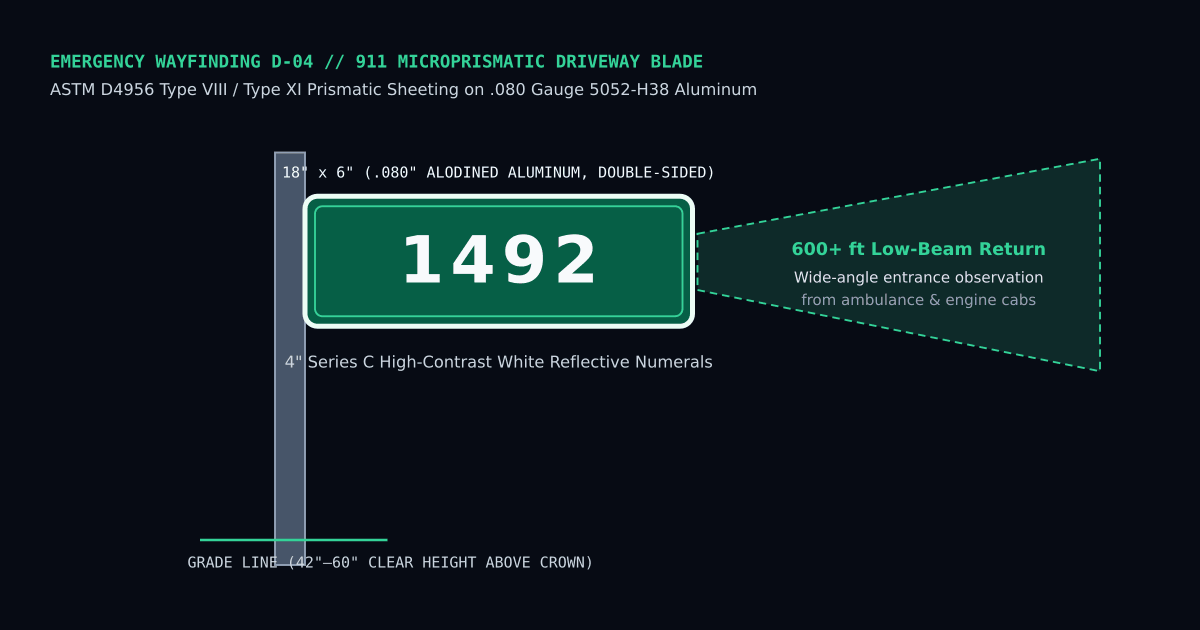
On rural acreage, wooded Winding lanes, lakefront parcels, and deep suburban flag lots where the main residence sits more than 100 feet from the pavement—or disappears behind pines and terrain rises—a porch-mounted plaque is invisible from the road. County E-911 coordinators and rural fire districts rely on double-sided retro-reflective driveway blades mounted at the road apron to spot the turnoff before overshooting at highway speed.
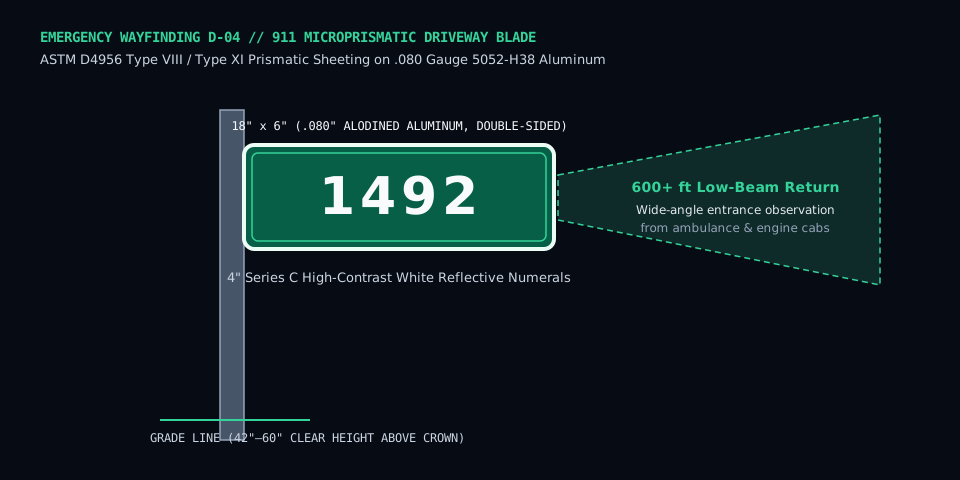
Engineer Grade vs. High-Intensity Prismatic vs. Diamond Grade (ASTM D4956)
Two green-and-white metal signs can look identical on a sunny afternoon in your hands yet perform completely differently in pouring rain at midnight. Retro-reflective sheeting bounces vehicle headlight rays directly back toward the driver's eye line along the incident cone—and ASTM D4956 grades quantify how much light actually returns:
| ASTM D4956 Sheeting Class | Optical Construction | Typical Retro-Reflectivity (White, cd/lx/m2) | Outdoor Weathering Lifespan | Best Emergency Signage Use Case |
|---|---|---|---|---|
| Type I (Engineer Grade) | Enclosed glass-bead film | 70 - 100 | 5 - 7 years | Low-speed private HOA lanes with streetlamps; fades earliest under UV |
| Type IV (High-Intensity Prismatic) | Unmetallized microprismatic cube corners | 360 - 500 | 10 years | Standard county E-911 rural driveway posts on 25-45 mph roads |
| Type VIII / Type XI (Diamond Prismatic) | Full-cube wide-observation microprisms | 580 - 800+ | 10 - 12+ years | High-cab fire engines, wide-angle curved approaches, unlit 55 mph highways |
Notice the hidden optical detail in the top row versus the bottom row: ambulance and fire-apparatus windshields sit 3 to 4 feet higher above the headlights than a compact sedan driver's eyes. That wider observation angle causes basic Type I glass-bead stickers to look dim from a tall truck cab, whereas full-cube Type VIII and Type XI microprismatic sheeting redirects a wide cone specifically engineered for commercial and emergency cab heights.
Why County Color Codes Vary: Green, Blue, Red & Brown Blades
Before ordering a 6-by-18-inch reflective blade, check your county E-911 addressing ordinance or volunteer fire district specification sheet. While Manual on Uniform Traffic Control Devices (MUTCD) street-name conventions inspire most residential blades, counties standardize distinct background colors to communicate road jurisdiction or water supply at a glance:
- Highway Green with White Numerals: The most widespread E-911 standard across North America, matching public street-name guide sign contrast.
- Safety Blue with White Numerals: Mandated across numerous Midwest, Pacific Northwest, and wildfire-zone counties specifically to distinguish private residential E-911 markers from municipal road signs (or, in certain rural districts, to indicate proximity to a pressurized hydrant or dry-hydrant pond).
- Fire Red or Forest Brown: Adopted selectively by Wildland-Urban Interface (WUI) districts, national forest inholdings, and private ranch road associations.
Horizontal vs. Vertical Orientation & Two-Way Perpendicular Mounting
A single-sided sign facing parallel to the asphalt forces approaching crews to crane their necks at the last second. Always mount driveway markers double-sided and perpendicular (at 90 degrees) to the roadway using heavy-duty cast aluminum 90-degree U-channel or round-post brackets with stainless vandal-resistant bolts so drivers approaching from either north or south read the full numeral face 500+ feet ahead.
Between horizontal (18 in wide x 6 in tall) and vertical (6 in wide x 18 in tall) layouts, horizontal blades preserve natural left-to-right reading flow (`1492`) and hold the entire number above tall roadside grass or winter snowbanks. Vertical blades are best reserved for narrow wooden fence posts, stone gate pilasters, or mailboxes where lateral overhang could be clipped by mirrors or snowplow wings.
Shared Multi-Home Driveways & Fork Arrows
If two or more residences share a single apron off the county road, mount a combined stack listing all addresses driven by that entrance at the road, then install individual directional arrow blades at every internal fork in the gravel lane so responders never guess between left and right branches.
Substrate Gauge & Post Setback Checklist
- Never Use Thin .040 Gauge Sheet on Cantilevered Posts: Wind buffeting from passing semi-trucks bends .040-inch aluminum at the bolt flange within one storm season. Specify .080-inch (2.0 mm) rust-free 5052-H38 alodined aluminum with radiused corners.
- Height Above Road Crown: Position the bottom edge of the reflective blade
42 to 60 inchesabove the traveled road surface—above snow berms and bumper level, directly inside low-beam headlight sweep. - Lateral Clearance from Pavement Edge: Set your 1.12 lb/ft or 2.0 lb/ft galvanized/baked-enamel U-channel post
6 to 12 feetoff the pavement edge (within 10 to 15 feet of the driveway throat) and call 811 before driving any post into the utility right-of-way.
Need Sizing Verification or a Custom Plaque Quote?
Test your address on our Live Day/Night Halo Simulator or email your facade photo and street setback to info@housesignage.com.